Category: Small Business

Utilizing Free Advertising to Cut Start Up Costs

In business nothing is more important than the bottom line. With the cost of business rising, the line for spending definitely needs to be the lowest possible. Start-ups are in a position today that twenty years ago was non existent. With internet marketing constantly being honed and simplified, start-ups can now advertise for free and get their business started right. Here are a few ways of marketing your business online without spending a dime:

Social Networks:

I am starting with social networks for one reason; it should be where you start. Social networking can allow your startup to reach thousands of people in seconds. However that is only once you have it set up properly.

Start by setting your social up during the planning of your start-up. Once you know what your business will be about, the product or service you will be offering and the areas you will be offering it in, sign up for the popular networks. Facebook, Twitter and LinkedIn, are the current monsters of social networking. You should create your account and begin adding users, finding followers, and following others (follow SimplifyThis on Facebook now) to begin building a database of people who will see your ads and posts later.
Read More

Lessons Learned on the Way Up

By Jonathan Wickman

When I think about the person I was when I started my career, it makes hard for me to believe I have come as far as I have.  Most of the personal development I have had the last several years has come directly from the office.  The lessons I have learned have helped me become a better husband and father.  Here, a few of the lessons I’ve learned in the workplace, that have helped me to be a better professional and person.

Importance of Mentors

I started my professional career with an internship at Utah Valley University. I was majoring in marketing but had no real hands on experience.  I was lucky enough to score a job with an online marketing company. At the time, I didn’t know the first thing about using the Internet to marketing to people.  The company only had the 3 owners and 2 interns.  I would come in everyday and work my hardest on the tasks I was assigned.  I learned quickly that if I put my nose to the grindstone and had a good attitude, one of the owners would give me a little bit of one on one training.  This mentoring has proven to be invaluable to me in terms of building my knowledge. If you work hard for people, they are much more inclined to mentor you. As a small business owner, you can also turn to the Small Business Administration’s (SBA’s) SCORE  program for personalized one-on-one small business advise! The SCORE program, standing for Service Corps of Retired Executives is credited with training 590,550 aspiring and existing small business owners in 2010. Those businesses generated $19.4 billion in revenue. Their dedicated volunteers represent over 270,000 years of experience across 62 industries. Amazingly, SCORE is completely FREE, making SCORE a must-do for any small business owner.
Read More

Grow Your Profits with Customer Retention

Customer retention is central to successfully building a business. As many of you already know, it’s easier to sell to an existing customer than a new one. If you’re not already aware of the importance of customer retention, here are a few facts:

  • According to some studies it costs up to 7 to 10 times more to acquire a new customer than to keep an existing one.
  • Studies also show that a 10% increase in customer retention can translate to as much as an 80% increase in profitability.
  • They also state that a 2% increase in customer retention has the same effect on a business as decreasing costs by 10%.

Overall, customer retention should be central to your small business marketing activities. Not surprisingly customer retention relates directly to the strength of your relationships with your clients. Follow these tips to keep your relationships strong, and retention rates high.
Read More

Office Organization Tips to Increase Your Efficiency

Nothing can make you more unproductive than not being able to find what you need when you need it. While you may see yourself as being busy all the time, how much of that “busyness” involves searching for something and not being able to find it?

Better is to spend just a little bit of your daily work time setting up an organizing process that will have you 100% more organized by the end of the month.

It takes far less time to file a document properly than to do it over again because you can’t find it! By the same token, being able to find the staples you need for your stapler immediately will take far less time than another trip to the store, when you know you have a new box of staples lying around somewhere.

The old adage, “a place for everything” certainly applies here. A storage cabinet specifically marked for office supplies will make them far easier to find.
Read More

Why it is Important for Your Small Business to Accept Online Payments

10 years ago the only reliable methods for accepting payments for most small business owners were face-to-face, credit cards over the phone or billing through the mail. As technology has advanced and people have become more Internet savvy, the possibility for payment processing has opened up and now allows small businesses similar opportunities as their larger competitors.

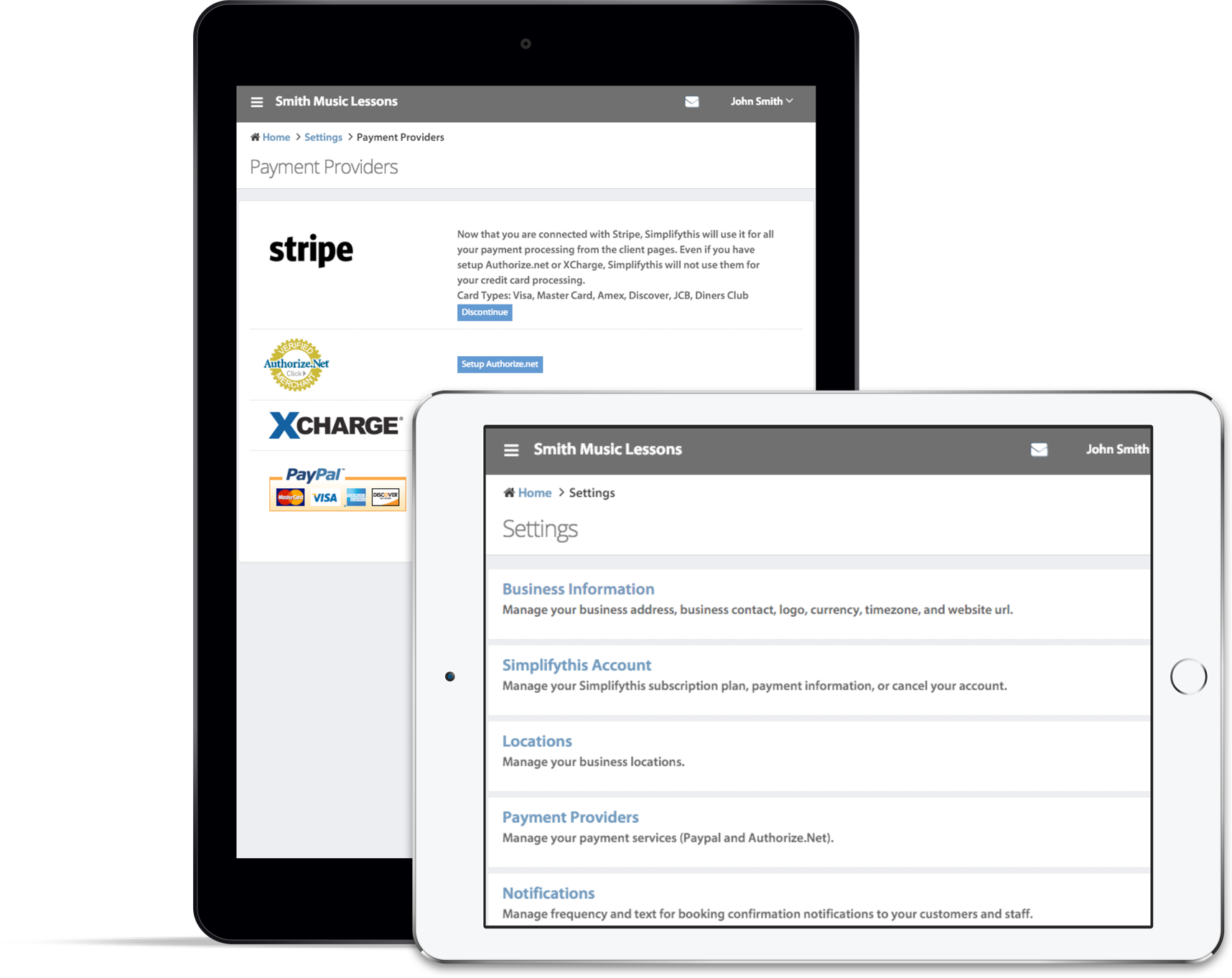
Until recently, accepting online payments was too costly for many small business owners, and too confusing to manage on their own. With payment gateways and payment processor agreements, it was often easier to mail invoices as they have done for decades. That is not the case anymore. With simple to install, low cost online invoicing solutions such as SimplifyThis, business owners everywhere can enjoy the benefits of automatic, online payment processing.
Read More

Elements of a Strong Brand: Vision, Mission, Values and Personality

Apple, one of the world's most recognized brands, is known for its value of innovation

Developing a brand strategy can help a business to get more customers and to have an easier time selling. The down side of developing a brand strategy however is the time it takes. Still, understanding your audience, positioning, goals and the benefits of your product or service—all elements of a brand–are crucial for success. There are softer elements of a brand too, which depending on the business can be equally important to understand. Having a clearly defined brand vision and mission can help to propel a business forward. These elements serve to inspire people working at the company—including the business owner—as well as customers. Vision, mission and values speak to people on a human and emotional level, helping people to connect with the brand, and also to develop loyalty.

Developing a clear vision and mission can take some soul searching. Be patient with yourself as you go about defining these elements, and remember, your brand strategy will never be perfected. Perfection isn’t the point. As you create vision, mission, values and personality statements, don’t worry about the words you use as much as the concept of what you are saying. You can go back and edit these statements later. First priority is to understand these elements in conceptual terms.
Read More

Do You Need a Brand Strategy?

Having a strong brand helps businesses to attract the right customers and make sales more easily.  It takes multiple encounters with a product or service before people buy, and having a strong and consistent brand helps people to connect with and remember you. A brand strategy is a tool that helps you to accomplish a strong and consistent brand. Many new business owners think of brand and branding in terms of a logo. Your logo in fact is part of your company’s visual identity, but before you design your logo there are more fundamental aspects of your brand, such as your mission, positioning, values, personality and more. A strategy clearly defines these and other primary elements in order to guide such key decisions as what to name your company, whom to hire, what your logo should look like, where to market and advertise, and even how to conduct your business.
Read More

Audience, Goals, Benefits & Positioning: Crucial Elements of Your Brand Strategy

There are many elements that together make up a strong brand, including a mission, vision, personality and values. Taking the time to define these elements as part of creating a brand strategy is a very worthwhile, albeit often time consuming endeavor. It’s not uncommon for a company to enter the market place without creating a brand strategy. There are people in business for decades who’ve never formally created a brand strategy. There is the question however of what if they had? Whether you have time to toil over your mission statement or not, there are several elements of your brand that are especially important to understand and that are the foundation of all of your marketing materials. They are: target audience, positioning, goals and benefits.

Target Audience:  Knowing your target audience is the single most important aspect to a strong brand strategy. If you don’t know your target audience, intimately and specifically, all of your marketing materials will be shooting in the dark. Not knowing your audience is a common marketing mistake many small business make for various reasons including that people are afraid to exclude possible potential customers. There are a few things to understand about identifying a target audience:

  • Target audience is about targeting who is most likely to buy, not everyone who could feasibly buy from you, and not whom are you willing to sell to.
  • Target audience is about identifying your ideal customer, not your average customer.
  • As the marketing idiom goes, when you try to reach everyone you reach no one. Trying to include everyone in your target audience is sure to lead to watered down communications that don’t land with anyone.

In identifying your audience, you want to know the key demographics, i.e. male/female, age, education, household income, geographic location, profession, marital status. You also want to understand the psychographics: attitudes, aspirations, and other psychological criteria. Also you want to know where they are and how you will best reach them.

Benefits: Understanding the benefits of your service are product is also key to business success. Benefits are distinct from features. The difference between features and benefits is important for any business owner to understand. Example, a yoga studio offers one-on-one classes. The one on one class is a feature of that yoga studio. The benefit is what comes from that feature, like individual attention leading one to get more out of each class. Getting more out of each class would be the benefit. You want to “sell” the benefit, as that will resonate most with potential clients. In buying a product or service, people want to know what’s in it for them. Knowing your benefits is important for verbally being able to describe your business, and also on visual materials like your website, brochures and ads. To get clear on how your service or product benefits your audience create a list of three to five main benefits your brand offers, do this from a customer’s pint of view. Start by writing down five to seven features of your business, and then a benefit of each. This can take some time, but is worth the work.

Positioning:  Know the essence of how your business is different from others in the same space. Your positioning statement is an internal document that guides you in knowing how you are different from the competition. Ask yourself how are you unlike others in your field in your market. A good format for your positioning statement is: “For [customers], [product name] is the [product type] that [top benefit]. Unlike [competitor], [product name] [differentiator]. Since this is an internal document, you don’t have to worry about how well it reads, you need to focus on the concept of it, and understanding yourself how you are different from your competition.

Goals: Finally, goals are at the center of any marketing initiative. Goals give your activities direction, without them you are merely accepting what is handed to you rather than driving your business toward a destination that is important to you. As part of understanding your brand strategy, take the time to identify three business goals that will remain at the center of your marketing activities. Be sure to use the SMART goal setting method.

Understanding your target audience, benefits, positioning and goals is paramount to maximizing your ability to market and sell your services or products. While understanding and defining these brand elements will take you some time, doing so will give your business and marketing the strategic direction that successful brands have. You can also take a look at your brand’s vision, mission, values and personality to round out your brand strategy.

A Few Simple Techniques for Increased Productivity

There are hundreds of legitimate tips for increasing productivity out there in books and on the internet. If you are struggling in the realm of personal productivity at work, it is worth it to research the topic and to select a few of the tips that speak to you. Don’t overdo it, however. No need to follow every tip out there. Be careful not to over-engineer your plan for increased productivity, as it’s tempting to do this—the point isn’t to have a perfect plan for productivity, it’s to become more productive. Focusing on and committing yourself to a few techniques should do it.

Three Techniques for Increased Productivity

Be realistic about time. Most of productivity comes down to good time management.  An important first step in managing your time effectively, is having a realistic read on how you are currently spending your time. This includes having a realistic view of how long each of your regular tasks takes you from start to finish—realizing that you are an individual and you have your own process for accomplishing things. Let’s say you’re a graphic designer and you designate a certain number of hours to designing a piece for a client, but part of your design process includes milling about your apartment and washing the dishes while you dream up ideas and inspiration. If doing that is part of your process then it should be included in the number of hours you estimate it will take you to complete that type of project. No sense in carving out two hours for a task if in actuality it takes you three. Being realistic about your time, as you currently spend it, will help you to create time management plans that will work for you.

Honoring your word. Let’s face it, many dreams and ambitions go to the wayside as motivation and focus wane. Sustained motivation and focus fuel the hundreds of action steps that add up to the successful achievement of a goal. There are again a plethora of tips on how to stay motivated . But the one I like most for its simplicity is the concept of honoring your word. It’s really simple to follow: do what you say, because you said it. Following this rule and putting your word above all is simple and it frees you from the time wasted in constantly re-thinking the merits of completing different tasks. Another plus, when you do what you say—and simply because you said you would do it—you feel great. It’s related to a greater sense of integrity, which can become a motivating force in and of itself.

Progress not perfectionism. While we each have our own standards, and we need to adhere to them, perfectionism is a common productivity killer. Perfectionism is in fact a procrastination technique. Your goal should be to move your project forward a little bit each day and to feel good about your progress. This will be more motivating then trying to perfect things. Try following these tips for letting go of perfectionism.

DIY Marketing for New Entrepreneurs

With a plethora of free marketing platforms available entrepreneurs are readily taking a do-it-yourself approach toward marketing. Here are some tips to help your D.I.Y. efforts go smoothly.

The exhiliration and empowerment of D.I.Y.

Advancements in technology have made marketing a DIY affair for many small business owners. Now more than ever, ordinary people can be publishers using popular blogging software like WordPress and Tumbler, email software like Constant Contact and social media tools such as Facebook and Twitter. These tools have become primary methods for promoting a business, supplanting more expensive marketing approaches like advertising in print or on the radio or TV. Today, with the primary marketing tools accessible to all people, it pays for small business owners to adopt a proactive attitude toward managing their own marketing. Fully utilizing these tools can often be daunting for many business owners—particularly people for whom technology entered onto the scene in their adult lives. For many, the concept of being able to update their own websites seems farfetched, requiring greater skill than they have. The truth is, anyone can learn to use these tools, all that’s necessary is a can-do attitude and a healthy outlook on learning.

Follow these tips to aid you in your journey toward self sufficiency in the marketing realm.

Make friends with Google: As a business owner and marketer in today’s world, Google is your BFF. Don’t know how to add a new page to your WordPress site? Google it. Read several of the results so that you can get a consensus. Gone are the days of needing an expert to solve your technology and marketing problems. As long as you know how to Google you have the answer you need at your finger tips. This fact represents something of a paradigm shift. In the old way, there were experts who had information that you typically had to pay for to access. Today, all sorts of people openly share their experiences online in forums and blogs. The question here isn’t whether you should Google the answer, it’s how to Google. Get the most out of the popular search engine by following some of these advanced Search tips.

Don’t call until you search: RTFM may be rude, but in sensibility, it is probably the first commandment of technology. Standing for read the ** manual, RTFM is a rude albeit common sentiment found online. While it’s not recommended as a way of treating people, it does represent a certain level of responsibility that is  expected in the online world these days. Let go of the idea that someone out there will hand the answers to you. That’s how it worked in the ‘90s. Don’t call your friend who knows a lot about technology until after you have researched the solution yourself. It’s simply the appropriate way conduct yourself in the online world. Similarly, let go of the idea of customer support. Have you ever tried to get on the horn with Facebook to ask them how you should go about running ads?  It doesn’t happen. With the plethora of free platforms, customer service is becoming passé. Adapt. The sooner you do, the sooner you’ll experience the freedom and power of being able to D.I.Y.

Don’t make it mean anything about you: This tip can really be extended to the rest of your life as well, but we’ll keep it focused on your use of technology as it relates to marketing your business. The thing is you will bump up against issues, problems, times when you do not know how to do what you need to do. There’s a chance you’ll feel yourself tighten up, become frustrated and aggravated, overwhelmed by the task ahead of you—we’ve all been there. When that happens you have a couple of choices. You can a) make it mean that there’s something about you that is leaving you unable to complete the task i.e. you’re too old, not technical enough, dyslexic—these are all actual reasons I’ve heard from small business owners bumping up against technology woes. Or you can b) slow down, take a deep breath and realize that all it means is that you have something to learn. There’s some piece of information that you don’t have. Once you do have it, you will be able to move through whatever it is you’re doing. To get that information, see points one and two.

Remember as you go on with D.I.Y. digital marketing activities, be confident. Most of the information you need is there online for you to read and apply. Even the experts are self taught—you can do it too. Succeeding online is less about technical prowess, and more about attitude and a willingness to learn new things. The fact is, the digital landscape rapidly changes–even the experts need to constantly update their knowledge and teach themselves new techniques as they go along.

WP Like Button Plugin by Free WordPress Templates